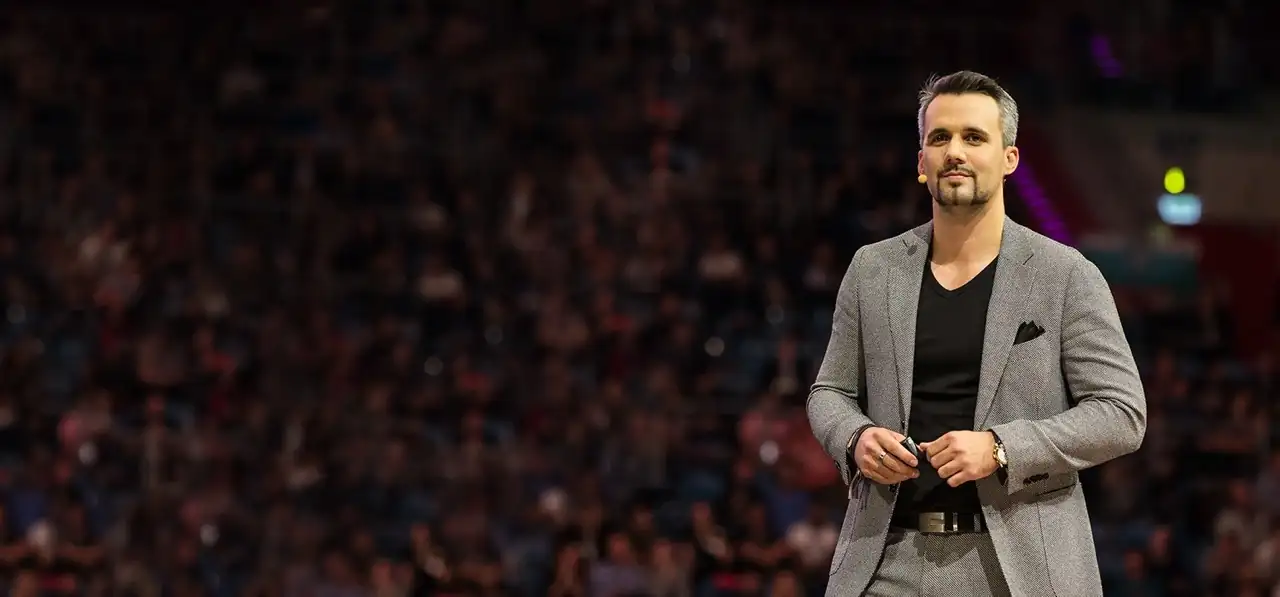
Forty-five minutes into a show at a corporate event in Linz, something happened that I’d only experienced a handful of times before. I stopped thinking about what I was doing. Not in a careless way — in the opposite way. Every movement was precise. Every word landed exactly where I intended. I could feel the audience’s attention like a physical thing, and I could move it at will. Time behaved differently — the forty-five minutes felt like ten. When the show ended, I had the distinct sensation of waking up from something.
Performers call this “the zone.” Psychologists call it “flow state.” Athletes call it “being in the pocket.” Whatever you call it, it’s the state of full presence where the gap between intention and action closes to nearly zero. You’re not planning what to do next — you’re doing it. You’re not evaluating how it’s going — you’re experiencing it. You’re not managing the audience — you’re connected to them.
The zone is the superpower of performance. Shows performed in the zone are measurably better than shows performed outside it. Audience responses are stronger. Technical execution is cleaner. Timing is tighter. The performer’s energy is higher without feeling forced. Everything works at a level that deliberate effort alone can’t achieve.
The problem: you can’t force the zone. But you can create conditions that make it more likely.
What the Zone Actually Is
Flow state, as identified by psychologist Mihaly Csikszentmihalyi, has specific characteristics:
Complete absorption in the activity. You’re not thinking about your grocery list, your next meeting, or your performance anxiety. Your entire conscious awareness is focused on the current moment of the current activity.
Loss of self-consciousness. You’re not monitoring how you look, how you’re being evaluated, or whether the audience likes you. The self-evaluative part of your brain has gone quiet, leaving more cognitive capacity for the activity itself.
Altered sense of time. Time either speeds up (an hour feels like minutes) or, less commonly, slows down (a crucial moment seems to stretch). The normal clock-watching awareness disappears.
Automatic action. You’re not deciding what to do — your training and preparation produce the right action without conscious deliberation. The preparation has been internalized so deeply that execution happens below the level of conscious thought.
Intrinsic reward. The activity is its own reward. You’re not performing for the applause or the paycheck. In the zone, the doing is the reward.
The neurological basis for flow involves a temporary reduction in activity in the prefrontal cortex — the part of the brain responsible for self-monitoring, time awareness, and critical evaluation. When this area quiets down, the motor and creative centers operate with less interference. You’re literally thinking less and performing better.
This neurological insight explains something performers have observed for centuries: the best performances happen when you stop trying so hard. The effort of monitoring and controlling your performance actually degrades it. The zone happens when that monitoring releases.
The Zone Prerequisites
You can’t summon the zone at will. But research and my own experience have identified four prerequisites that make flow state significantly more likely:
Prerequisite 1: The skill-challenge balance.
Flow occurs when the challenge of the task matches your skill level. Too easy, and you’re bored — your brain doesn’t engage fully. Too hard, and you’re anxious — your brain engages in threat monitoring rather than fluid performance.
The sweet spot is a challenge that’s approximately 4% beyond your current comfort level. Hard enough to require your full attention. Not so hard that it triggers fear of failure.
For performance, this means your material should be well within your technical capability (so the mechanics don’t require conscious attention) but still engaging enough that you can’t sleepwalk through it. A piece I’ve performed hundreds of times is too easy for flow. A piece I’m performing for the first time is too challenging. A piece I’ve performed fifty times but still find engaging — with enough variation in audience dynamics to keep me alert — is the sweet spot.
This connects to why I advocate for deep practice at specific difficulty levels. Practice that consistently targets the 4% beyond-comfort zone isn’t just building skill — it’s training your brain for the challenge level where flow lives.
Prerequisite 2: Clear goals and immediate feedback.
Flow requires knowing what you’re trying to do and getting real-time information about how well you’re doing it. In performance, the goal is clear (deliver this show to this audience) and the feedback is immediate (the audience’s reactions, energy, and attention tell you moment-by-moment whether you’re connecting).
This is one reason performers often experience flow more easily than, say, office workers. Performance provides constant, unambiguous feedback. An audience’s laughter tells you the joke worked. Their silence tells you the dramatic moment landed. Their fidgeting tells you the energy is dropping. You’re never in the dark about the effect of your actions.
Prerequisite 3: Thorough preparation.
This seems contradictory — how can preparation (which happens before the zone) be a prerequisite for the zone (which happens in the moment)? Because the zone requires automatic action, and automatic action requires that the material has been practiced until it’s internalized below conscious thought.
A performer who has to think about their next line or their next move can’t enter the zone because conscious thought is required for execution. A performer whose material is so deeply practiced that it flows without conscious direction has freed the cognitive space needed for flow.
This is why the rehearsal process matters so much. Thorough rehearsal isn’t just about reliability. It’s about creating the internalized competence that allows flow state to occur.
Prerequisite 4: Low external distraction.
Flow is fragile. A ringing phone, an interruption, or an environmental distraction can snap you out of the zone instantly. Once broken, re-entering the zone typically takes fifteen to twenty minutes — which means that for many performance contexts, a single interruption can prevent flow for the remainder of the show.
Managing your performance environment to minimize potential interruptions is partly about reliability and partly about protecting the conditions for flow. When I perform, I coordinate with event organizers to minimize potential disruptions: phones silenced, wait staff paused during key moments, side doors closed. Not because I’m precious — because each potential interruption is a potential flow-killer.
Training for the Zone
While you can’t force flow, you can train for it. Specific practices increase both the frequency and the depth of flow experiences.
Practice 1: Single-tasking discipline.
The modern habit of multitasking is flow-poison. Your brain cannot enter flow while simultaneously monitoring email, checking notifications, and switching between tasks. Single-tasking — doing one thing at a time with full attention — is the daily practice that builds the attentional muscles flow requires.
I practice single-tasking by working in focused blocks: forty-five minutes of one activity with all notifications disabled, followed by a fifteen-minute break. During the focused block, I do nothing else. Not a glance at my phone. Not a quick check of email. Nothing but the one activity. This isn’t natural in our attention-fragmenting environment, which is exactly why it needs to be practiced.
Practice 2: Pre-performance routine.
A consistent pre-performance routine signals your brain that it’s time to enter performance mode. Like an athlete’s pre-game ritual, the routine creates a psychological transition from everyday awareness to performance awareness.
My pre-show routine is twelve minutes long: five minutes of quiet reviewing my set list mentally (not rehearsing — reviewing), three minutes of slow breathing, two minutes of physical warm-up (hand exercises, shoulder rolls), and two minutes of standing quietly in the performance space, feeling the room.
I’ve done this routine before every significant performance for years. My brain now associates the routine with the transition to performance state, which means the routine itself starts the process of settling into the focused awareness that precedes flow.
Practice 3: Post-flow documentation.
After every performance where I experience flow (or near-flow), I document the conditions: what was I doing before the show, how did the audience feel, what was my energy level, at what point in the show did flow start, and what triggered it or what prevented it.
Over time, this documentation reveals patterns. I enter flow more easily after a good night’s sleep. I enter flow more easily with audiences of thirty to eighty people (small enough to be personal, large enough to generate collective energy). I enter flow more easily when the venue has good acoustics. I enter flow less easily when I’m performing new material (the challenge level is too high) or material I’m bored with (the challenge level is too low).
Knowing your flow patterns allows you to optimize conditions. I now actively try to schedule important performances after rest days and in venues that match my optimal conditions.
Flow Beyond the Stage
Flow isn’t limited to performance. I experience it in writing (when the words come faster than I can type), in product development (when a design problem suddenly resolves), and in coaching sessions (when the conversation enters a zone of genuine connection and insight).
The same prerequisites apply in every context: skill-challenge balance, clear goals with immediate feedback, thorough preparation, and low distraction.
For business builders, the most accessible flow activities are typically:
Writing. The combination of creative challenge, immediate visible output, and the absence of interruptions makes focused writing sessions prime flow territory.
Deep problem-solving. A complex business challenge that requires your full attention but is within your capability range. Not routine tasks (too easy) and not existential crises (too threatening).
Client conversations. When a consulting or coaching conversation enters a zone of genuine exploration, both parties can experience flow. The conversation becomes its own reward and produces insights neither party could have reached alone.
The misdirection principles I’ve written about are, in a sense, about managing the audience’s attention to create a collective flow-like experience. When the audience is fully absorbed in the performance, they’re experiencing their own version of the zone — complete presence, loss of self-consciousness, altered time perception. The performer’s job is to create the conditions that make audience flow possible.
The Zone as a Sustainable Practice
One caution: the zone is not sustainable as a constant state. Flow requires intense focused attention, which consumes significant cognitive and emotional resources. A performer who experiences flow for a sixty-minute show needs recovery time afterward. A writer who flows for three hours will be cognitively depleted for the rest of the day.
The sustainable approach is to protect specific windows for flow-potential activities and treat those windows as the highest-value time in your schedule. My flow windows are: performance events (where flow serves the audience), morning writing sessions (where flow serves content production), and deep practice sessions (where flow serves skill development).
Outside those windows, I operate in normal, non-flow working mode: meetings, email, administrative tasks, planning. These activities don’t require flow and shouldn’t attempt it. The contrast between flow windows and operational windows is what makes both sustainable.
Takeaways
- The zone (flow state) occurs when your skill-challenge balance is right, goals are clear with immediate feedback, preparation is thorough enough for automatic action, and external distractions are minimized.
- You can’t force flow, but you can increase its probability through single-tasking discipline, a consistent pre-performance routine, and post-flow documentation that reveals your personal flow patterns.
- Thorough preparation is paradoxically the most important flow prerequisite. Material practiced until it’s internalized below conscious thought frees the cognitive space that flow requires.
- Flow applies beyond performance to writing, problem-solving, and deep conversations. The same four prerequisites apply in every context.
- Flow is not sustainable as a constant state. Protect specific windows for flow-potential activities, treat them as your highest-value time, and accept that operational work outside those windows operates in normal mode.