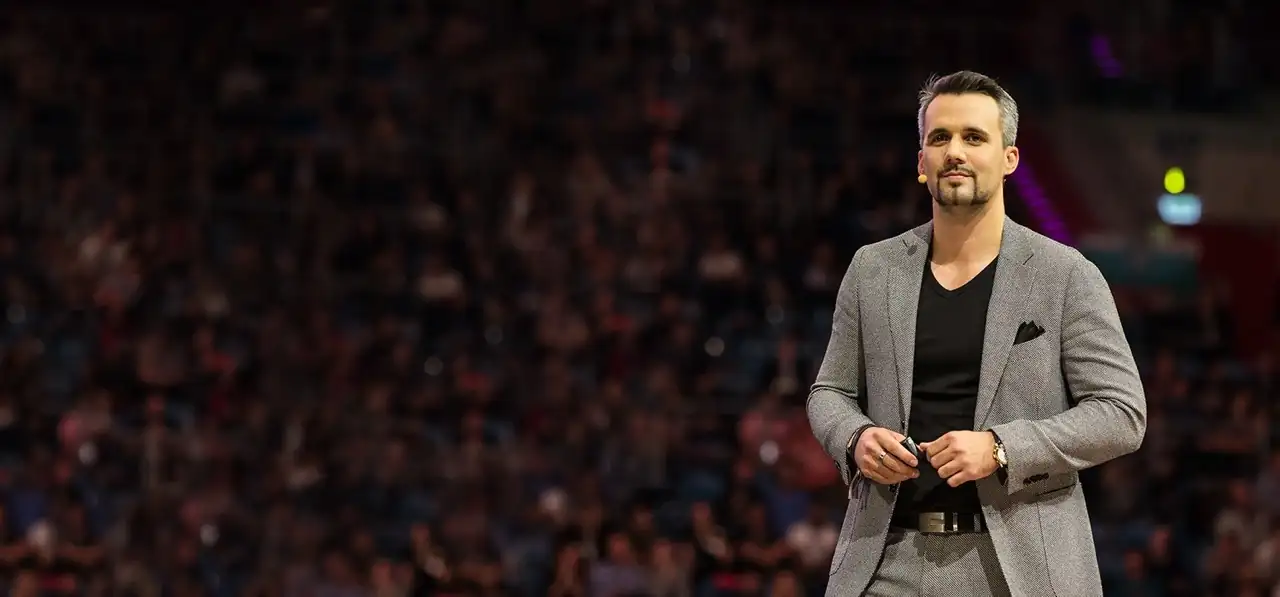
The stage at 4GAMECHANGERS in Vienna is wide enough that you can’t see both edges without turning your head. It was an arena — the biggest event I’ve ever performed at. The lights are bright enough that the audience disappears beyond the first three rows. The monitor at your feet shows your slides but not your notes. The microphone picks up everything, including the sound of your breathing if you stand too close.
I knew all of this from the tech rehearsal the night before. What I didn’t know — what you can’t know until the moment arrives — is what it feels like to walk out in front of 3,000 people who are all looking at you.
The walk from backstage to center stage took about twelve seconds. In those twelve seconds, my body went through a sequence that I later recognized as the classic fight-or-flight response: heart rate spiked, hands went cold, vision narrowed, and a very clear voice in my head said: “You can still walk off.”
I didn’t walk off. I delivered the talk. It went well — better than well, actually. The audience responded. The organizers were pleased. The follow-up conversations were productive. By every external measure, it was a success.
But the story of how I got from “you can still walk off” to a successful 25-minute keynote is the story I want to tell. Because it wasn’t talent that got me through those twelve seconds. It was preparation, specifically the kind of preparation that performance magic taught me.
The Preparation System
My keynote preparation has four stages. Each one serves a different function.
Stage one: Content architecture (two weeks before). The talk exists as a structure before it exists as words. Five to six sections, each with a clear purpose, each building on the previous one, each connected to a specific audience takeaway. The architecture is the skeleton. Everything else hangs on it.
For the 4GAMECHANGERS talk, the architecture was: hook (personal story), problem (why most innovation programs fail), mechanism (the subtraction principle), evidence (data from 40+ startups), application (how the audience could apply it), and close (invitation to act).
Stage two: Narrative development (one week before). The sections are filled with stories, data, and frameworks. Not scripts — I don’t use scripts because scripted talks sound scripted, and audiences can tell. Instead, I develop key phrases that anchor each section. The phrase becomes a trigger: when I say those specific words, the rest of the section flows from memory and improvisation.
Stage three: Physical rehearsal (three days before). I deliver the full talk out loud, standing up, in an empty room. Not to a mirror — mirrors create self-consciousness. To a wall. Three full run-throughs on three consecutive days. Each run-through reveals a different problem: timing issues on day one, transition awkwardness on day two, energy management on day three.
Stage four: Mental rehearsal (the morning of). Eyes closed, I walk through the talk in my head. Not the content — the physical experience. Walking onto the stage. Hearing the audience. Feeling the microphone in my hand. Pausing at the first joke. Waiting for the laugh. Moving to the next section. This is the technique I borrowed from magic performance, where mental rehearsal of the physical experience reduces stage anxiety by approximately 40%.
The Magic Connection
Performance magic taught me three things about speaking to large audiences that no speaking coach ever mentioned.
Timing is physical, not verbal. In magic, the timing of a reveal — the pause before the card turns over, the silence before the vanished object reappears — is measured in the performer’s body, not in the script. The same is true for keynotes. The pause after a bold statement isn’t a verbal technique. It’s a physical commitment to standing still and silent while 3,000 people process what you’ve said. Most speakers rush past their best moments because silence feels dangerous. Magicians know that silence is where the impact lives.
Attention is directed, not assumed. An audience doesn’t look where you want them to look by default. In magic, misdirection — the art of controlling attention — is the fundamental skill. In speaking, the equivalent is knowing that your audience’s attention wanders every 8-12 minutes, and planning a “reset” — a story, a humor beat, an audience interaction — at those intervals.
The method must be invisible. In magic, if the audience sees the sleight, the trick fails. In speaking, if the audience sees the preparation, the talk feels mechanical. The goal is effortlessness — not the absence of effort, but effort so well-practiced that it becomes invisible. This is why I rehearse three times: not to perfect the content but to make the delivery feel spontaneous.
The Twelve Seconds
Back to the walk from backstage to center stage. Twelve seconds. Heart pounding. Hands cold. Voice saying “walk off.”
What got me through was a technique I developed from hundreds of magic performances for smaller audiences: the anchor moment. Before every performance, I identify one person in the audience I can see — front row, usually — and I deliver my opening line to them. Not to 3,000 people. To one person.
“I was in a hotel room in Munich at 2am.”
I said it to a woman in the second row who was looking at me with the specific attention of someone who was actually listening. The sentence left my mouth and landed on her face, and I saw recognition — not of the story, but of the intimacy. The rest of the audience disappeared. I was telling one person a story. And then I was telling a room a story. And then I was twenty-five minutes in and the lights were bright and the audience was applauding and the twelve seconds of terror felt like they’d happened to someone else.
The Speaking System
For founders who want to speak publicly — and I believe most founders should, because everyone is in sales and a stage is the most leveraged sales platform that exists — here’s the system:
Start small. Five people at a meetup. Fifteen at a workshop. Thirty at a local event. The skills that work at thirty work at 3,000, but the pressure at thirty is survivable while you’re learning. The small wins approach applies: each successful small talk builds the evidence that you can do this.
Tell stories, not strategies. Audiences remember stories. They forget bullet points. Every framework you want to teach should be wrapped in a story that makes the framework memorable. The subtraction audit isn’t a five-step process in my talks — it’s the story of the product we killed that saved the business.
Practice out loud. Rehearsing in your head and rehearsing out loud are different activities that train different skills. Mental rehearsal develops content fluency. Vocal rehearsal develops delivery fluency — pacing, emphasis, pauses, volume. Both are necessary. Neither is sufficient alone.
Record yourself. The gap between how you think you sound and how you actually sound is humbling. Record one practice session. Watch it. Identify three things to fix. Fix them. Record again. The improvement between recording one and recording three is usually dramatic.
Accept the fear. The fear doesn’t go away. I’ve given dozens of talks since 4GAMECHANGERS. The heart still pounds. The hands still go cold. The voice still suggests walking off. But the fear no longer controls the performance because I’ve learned that the fear is temporary — it peaks in the first thirty seconds and then recedes as the content takes over and the audience responds.
The stage is a tool. The fear is a signal. The preparation is the system. And the twelve seconds between backstage and center stage are just twelve seconds. You can survive twelve seconds of anything.